Showing posts with label Modal Verbs. Show all posts
Showing posts with label Modal Verbs. Show all posts
Friday, 17 April 2020
MODAL VERBS OF DEDUCTION explained
Although we had already gone through how to express deduction in English, here you have an intertactive presentation for you to review and consolidate what you already have studied. Remember to click on the interactive buttons for more accurate info.

Saturday, 7 March 2020
MODALS OF DEDUCTION

We use modal verbs to say how sure we are about something.
1 must
We use must when we feel sure that something is true because there’s very strong evidence.
- He must live near here because he comes to work on foot. We don’t know where he lives but we’re sure it’s not far away.
- Come inside and get warm – you must be freezing out there.
- You’re a zookeeper? That must be very interesting.
2 might, may, could
We use might, may or could to say that we think something is possible but we’re not sure.
- Did you hear that? I think there might be a burglar downstairs. She’s not sure there’s a burglar but she thinks it’s possible.
- We’ll try to get there early but we may arrive late if there’s a lot of traffic.
- Don’t put it up there. It could fall off and hit someone.
3 can’t
We use can’t when we feel sure something is not true.
- It can’t be a burglar. All the doors and windows are locked. He doesn’t know it’s not a burglar but he feels sure it’s not.
- It can’t be far away now. We’ve been driving for hours. Where’s the map?
- Really? He has to work on Christmas Day? He can’t feel very happy about that.
Remember that all of these modal verbs – must, might, may, could and can’t have other uses.
Friday, 21 February 2020
HOW TO EXPRESS ABILITY
Having in mind some of you have problems to express ability in the different tenses, I thought of creating this mind map to help you understand how to use 'can', 'could' and 'be able to'. I'm not keen on building up mind maps but I hope it helps you understand how to express ability a bit better.
You can click on the image to enlarge it and/or save it to your device or you can go to 'grammar' to download it as a PDF document.
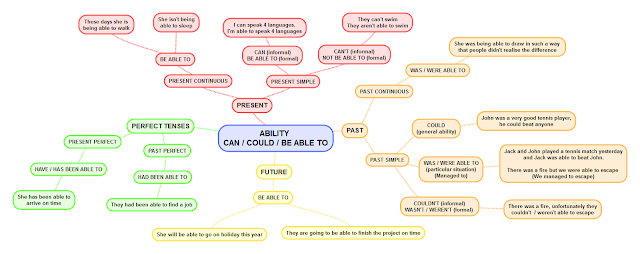
You can click on the image to enlarge it and/or save it to your device or you can go to 'grammar' to download it as a PDF document.

Thursday, 20 February 2020
CAN, COULD, BE ABLE TO

In the present both forms are possible, though can is more common.
We use could for general ability. But if we are talking about what happened in a particular situation, we use was/were able to... or managed to... (Not
They didn't want to come with us at first but we managed to persuade them. or ...we were able to persuade them, (but not 'could persuade')
Compare:
Jack was an excellent tennis player. He could beat anybody. (= he had the general ability to beat anybody)
Jack and Alf had a game of tennis yesterday. Alf played very well but in the end Jack managed to beat him. or ...was able to beat him. (= he managed to beat him in this particular game)
And now some exercises for you to practise:
Exercise 1
Exercise 2
Exercise 3
Exercise 4
Exercise 5
Exercise 6
And remember you can go to "Grammar" to download a more accurate explanation as a document.
Thursday, 23 January 2020
HOW TO EXPRESS OBLIGATION
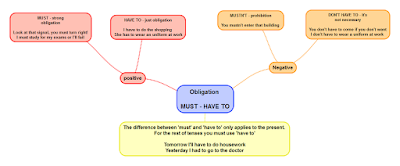
Here you have a mind map to help you when you have to express obligation. You can click on the image to enlarge it and/or save it to your device or you can go to 'grammar' to download it as a PDF document.

Wednesday, 22 January 2020
MUST - HAVE TO - SHOULD
Watch this video to revise the use of modal verbs of obligation.
And a couple of exercises for you to practise:
Exercise 1
Exercise 2
And a couple of exercises for you to practise:
Exercise 1
Exercise 2
Subscribe to:
Posts (Atom)