Showing posts with label UNIT 4. Show all posts
Showing posts with label UNIT 4. Show all posts
Thursday, 5 March 2020
PAST TENSES
Next lessons we will deal with past tenses. This is the presentation we will use to go through them, why don't you have a look at it before your lesson starts?

Wednesday, 4 March 2020
REFLEXIVE PRONOUNS

Exercise 1
Exercise 2
Exercise 3
Exercise 4
Exercise 5
Exercise 6
Additionaly, you can go to this BBC page to learn more about reflexive pronouns
Tuesday, 3 March 2020
ADJECTIVES -ED/-ING
Remember that we use -ed adjectives to talk about how a person feels and we use -ing adjectives to talk about the cause of that feeling. Go to 'Grammar' for a more accurate explanation. There you'll also find a list with the most common ones.
Watch this video to compare
And now try these exercises
- Exercise 1
- Exercise 2
- Exercise 3
- Exercise 4
- Exercise 5
Watch this video to compare
And now try these exercises
- Exercise 1
- Exercise 2
- Exercise 3
- Exercise 4
- Exercise 5
Friday, 21 February 2020
HOW TO EXPRESS ABILITY
Having in mind some of you have problems to express ability in the different tenses, I thought of creating this mind map to help you understand how to use 'can', 'could' and 'be able to'. I'm not keen on building up mind maps but I hope it helps you understand how to express ability a bit better.
You can click on the image to enlarge it and/or save it to your device or you can go to 'grammar' to download it as a PDF document.
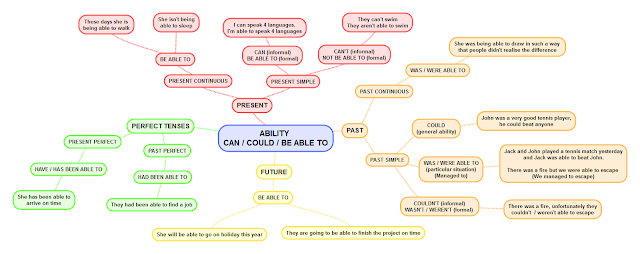
You can click on the image to enlarge it and/or save it to your device or you can go to 'grammar' to download it as a PDF document.

Thursday, 20 February 2020
CAN, COULD, BE ABLE TO

In the present both forms are possible, though can is more common.
We use could for general ability. But if we are talking about what happened in a particular situation, we use was/were able to... or managed to... (Not
They didn't want to come with us at first but we managed to persuade them. or ...we were able to persuade them, (but not 'could persuade')
Compare:
Jack was an excellent tennis player. He could beat anybody. (= he had the general ability to beat anybody)
Jack and Alf had a game of tennis yesterday. Alf played very well but in the end Jack managed to beat him. or ...was able to beat him. (= he managed to beat him in this particular game)
And now some exercises for you to practise:
Exercise 1
Exercise 2
Exercise 3
Exercise 4
Exercise 5
Exercise 6
And remember you can go to "Grammar" to download a more accurate explanation as a document.
Tuesday, 18 February 2020
GOOD MANNERS
Do you have good manners? Watch this video about good manners, what to say and do, polite English.
Friday, 14 February 2020
TELEPHONING
Useful telephone vocabulary and phrases in English.(If you want the document go to 'Vocabulary' to download it.
| Making contact : |
|
| Giving more information: |
|
| Taking a call : |
|
| Asking for a name / information : |
|
| Asking the caller to wait : |
|
| Connecting : |
|
| Giving negative information : |
|
| Telephone problems : |
|
| Leaving / Taking a message : |
|
Thursday, 13 February 2020

Thursday, 23 January 2020
HOW TO EXPRESS OBLIGATION
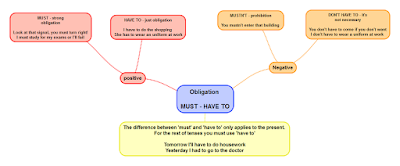
Here you have a mind map to help you when you have to express obligation. You can click on the image to enlarge it and/or save it to your device or you can go to 'grammar' to download it as a PDF document.

Wednesday, 22 January 2020
MUST - HAVE TO - SHOULD
Watch this video to revise the use of modal verbs of obligation.
And a couple of exercises for you to practise:
Exercise 1
Exercise 2
And a couple of exercises for you to practise:
Exercise 1
Exercise 2
Subscribe to:
Posts (Atom)